
Well Water Pumps Explained: How They Work and What Artesian Wells Need
Your well pump quits, and you’re stuck with no water. Let’s get straight to how these systems function so you can prevent that.
This guide will cover how well water pumps move water, the main components involved, and the specific setup requirements for artesian wells.
I’ve pulled and rebuilt more pumps than I can count, and the one on my property is no different. Ignoring your pressure tank is a sure way to burn out a pump motor fast.
How Does a Basic Well Water Pump System Function?
The goal is simple. The system moves water from deep underground into your home’s pipes. Think of it as your personal water utility, buried in your yard.
Here is the basic cycle. When you open a faucet, water pressure in your pipes drops. This drop triggers the pressure switch to turn the pump on. The pump pulls water up from the well and pushes it into a pressure tank. The pump runs until the tank is full and the water inside is compressed to a high pressure, usually between 40 and 60 PSI. Then the pressure switch tells the pump to shut off. Now you have a reserve of pressurized water ready for use.
You can picture the pressure tank like a bicycle pump filling a tire. As you pump more air into the tire, the air compresses and the pressure builds. In a water tank, the water (or a rubber bladder) gets compressed, creating the pressure that sends water to your shower when you need it.
Remember this. A “well pump system” or “pump well” means the entire setup. It is not just the mechanical pump in the ground. The pump, tank, switch, and piping all work together as one unit.
What Are the Main Parts of a Well Pump System?
Every part has a job. If one fails, the whole system can stop. Knowing what they are helps you troubleshoot.
The Pump
This is the heart. It sits either in your well casing or in your basement. There are two main types:
- Jet Pump: Used for shallow wells (about 25 feet deep or less). It often sits in a basement or well house and uses suction and pressure to pull water up.
- Submersible Pump: Used for deep wells. It is a long, cylindrical unit lowered right into the well water. It pushes water up, which is more efficient for greater depths.
The Pressure Tank
This is the lungs. It stores water under pressure so the pump does not need to start every time you flush a toilet. There are two common designs:
The bladder tank is far more reliable and maintenance-free, which is why it replaced the old style.
The Pressure Switch
This is the brain. It is a small box with a lever, usually attached to the pipe near the pressure tank. Inside, a diaphragm senses water pressure. When pressure falls to the “cut-on” setting (like 40 PSI), it closes an electrical circuit to start the pump. When pressure reaches the “cut-off” setting (like 60 PSI), it opens the circuit to stop the pump.
The Pitless Adapter
This is the secret passage. It is a special fitting installed on the well casing below the frost line. The water pipe from the pump connects to it inside the well. Outside, another pipe connects to it and runs horizontally to your house. This lets you remove the pump for service without digging up your yard, and it prevents freezing.
The Well Screen & Discharge Pipe
These are the gatekeepers. The well screen is a slotted section at the bottom of the well casing. It lets water in while keeping out sand and gravel. The discharge pipe is the specific pipe that carries water from the pump outlet up to the pitless adapter and into your home. It is built to handle constant pressure.
A Simple Mental Diagram
Picture this from the bottom up:
- Deep in the well: The submersible pump is suspended by the discharge pipe.
- Near the top of the casing: The pipe connects to the pitless adapter.
- In your basement: The pipe enters and connects to the pressure tank.
- On the pipe beside the tank: The pressure switch is mounted, monitoring everything.
When one part fails, you check the others. A pump that won’t stop running often points to a waterlogged pressure tank or a stuck pressure switch.
What Types of Pumps Are Used in Water Wells?
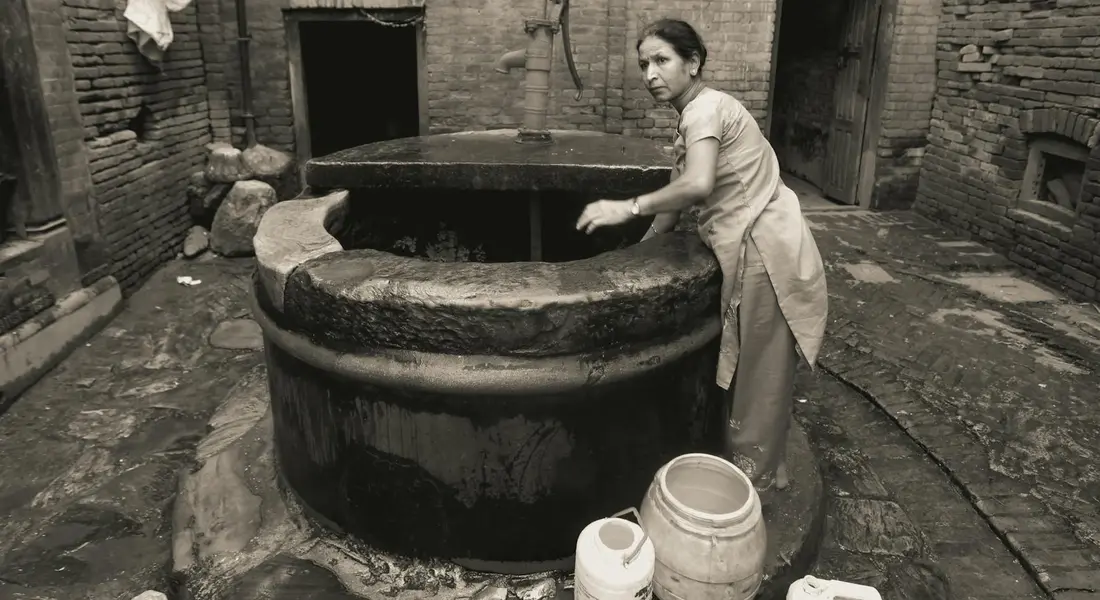
You have two main choices for getting water from your well to your house. One lives down in the hole, and the other lives in your basement.
Submersible Pumps vs. Jet Pumps
A submersible pump is one long, sealed unit that gets lowered deep into the well casing. The electric motor and the pump impellers are all together, sitting right down in the water. The big advantage of a submersible pump is that it pushes water up to your house, which is much more efficient for deep wells. Size and flow features—how much water it can move and at what pressure—are key when selecting the right unit. Matching the pump size to your well and household demand helps ensure steady water supply. Because it’s submerged, it’s also very quiet from inside your home.
A jet pump, on the other hand, sits in your basement or well house. It uses suction and pressure to pull water up from the well. It has one pipe going down into the water and needs to be primed. Jet pumps are simpler to service since they’re in your basement, but they struggle to lift water from depths greater than about 25 feet on their own. For deeper wells, a more complex two-pipe “deep well” jet pump system is needed. Choosing the right pump type depends on well depth, water yield, and maintenance requirements. This is a central part of choosing well water pump types.
Pumps for Shallow Wells vs. Drilled Wells
The type of well you have dictates the pump you need. This isn’t a suggestion, it’s a requirement.
A shallow well, typically less than 25 feet deep, can use a simple single-pipe jet pump. I’ve set these up for irrigation pits. They’re affordable and work fine for shallow water tables.
A drilled well, which can be hundreds of feet deep, requires a submersible pump. For any modern drilled well, from an average 100-foot household well to a deep artesian well, a submersible pump is the only practical choice. A jet pump simply cannot create enough suction to pull water from that depth, unlike submersible pumps designed for deeper applications.
Solar Well Pumps for Remote Use
If you have a well at a remote cabin or for livestock watering far from power lines, a solar-powered submersible pump is a solid alternative. These systems use solar panels to charge batteries that run a DC-powered pump. They are a dedicated solution for off-grid water delivery, but their output is generally lower than a standard AC submersible pump. You’re trading convenience and high flow for energy independence. If you need to pump well water without electricity altogether, consider hand pumps or gravity-fed systems. These non-electric options can complement solar setups for truly independent water supply.
The Modern Standard
Forget the old jack pumps you see in movies. For virtually every newly drilled residential water well today, a submersible pump is the standard, default installation. They are reliable, efficient, and capable of serving the needs of a modern home. When you hear a contractor talking about installing a well pump, they are almost certainly referring to a submersible pump.
Water Science Snippet: What’s in Your Well Water?
Before you can understand your pump, you need to know what it’s pushing. Your well water isn’t just H2O. It’s a mix of dissolved minerals and gases picked up from the rock and soil. Knowing what’s in it tells you what your pump is fighting and what might be building up in your pipes.
Define TDS (Total Dissolved Solids) and why it matters for pump wear and water taste.
Total Dissolved Solids, or TDS, is a simple number. It measures everything dissolved in your water, from calcium and magnesium to sodium and silica. Think of it like this: when you make coffee, the TDS is the dissolved coffee itself, not the water.
You measure TDS in parts per million (ppm) with a cheap meter. Good well water often reads between 50 and 250 ppm.
High TDS (above 500 ppm) is hard on your system and your taste buds. Water with high mineral content is more abrasive. Over years, it can accelerate wear on your pump’s impellers and seals. It often leaves more scale deposits in pipes and fixtures, restricting flow. For your taste, high TDS water can have a distinct mineral or even salty taste you might not enjoy.
Explain pH balance and its effect on plumbing corrosion.
pH tells you how acidic or alkaline your water is, on a scale from 0 (very acidic) to 14 (very alkaline). Pure water is a neutral 7. Well water should ideally sit between 6.5 and 8.5.
Low pH (acidic water) is a silent killer for your plumbing. Water with a pH below 6.5 is corrosive. It actively eats away at copper pipes, causing pinhole leaks. It dissolves metal from fixtures, leading to blue-green stains in sinks and metallic-tasting water. It can even shorten the life of your water heater tank.
High pH (above 8.5) isn’t as destructive but can cause scale buildup and make your water feel slippery.
Briefly mention hardness (GPG) in the context of why you might add a softener after the pump.
Hardness is a specific part of your TDS, focusing on calcium and magnesium. We measure it in Grains Per Gallon (GPG).
Water over 7 GPG is considered hard. Hard water is famous for leaving limescale crust in kettles, showerheads, and inside your appliances. That same scale can build up inside your plumbing, gradually reducing pressure.
This is the main reason you install a water softener after the pump and pressure tank. The pump brings the hard water up; the softener uses salt to swap the calcium and magnesium for sodium, preventing scale throughout the rest of your home. It protects your water heater, dishwasher, and every faucet.
Recommend simple test kits homeowners can use.
You don’t need a lab to start. A few basic tools give you a clear picture.
- A digital TDS meter: Plug it in, dip it in a glass of water, and get a reading in seconds. It costs less than a good steak dinner.
- A pH test kit: Look for a liquid drop test or test strips. They’re accurate enough for home use. I keep a strip test kit in my utility room and check my well’s pH every few months.
- A hardness test strip: Often comes in the same pack as pH strips. It gives you a GPG number so you can size a softener correctly.
For a full analysis, especially for safety, mail a sample to a certified lab. They test for bacteria, heavy metals, and other contaminants your simple kits can’t find. Do this when you first move in and every couple of years after.
What is an Artesian Well, and Does It Need a Pump?
Picture an underground layer of water trapped between two solid layers of rock or clay. This is an aquifer. An artesian well is a hole drilled down into a pressurized aquifer. The weight of the water at a higher elevation creates natural pressure, like squeezing a water balloon.
This pressure tries to push the water up your well pipe.
Flowing Artesian Wells: Water That Comes to You
A well where this natural pressure is strong enough to push water all the way to the surface, and keep it flowing, is called a flowing artesian well. You literally see water coming out of the wellhead.
If you have a steady stream of water coming from your well casing, you have a flowing artesian well. These are less common but they do exist. I’ve been on service calls where the main issue was managing this constant flow, not creating it.
Why Most Artesian Wells Still Use a Pump
Here’s the practical truth for homeowners. Even with natural pressure, it’s rarely enough for a modern house.
Your shower, dishwasher, and sprinkler system need consistent, strong pressure, usually between 40 and 60 PSI. The natural “artesian” pressure might only get water to the basement floor or create a weak trickle at the tap.
You need a pump to boost that natural pressure up to the usable level your appliances and fixtures demand. Think of the artesian pressure as a helpful head start. The pump does the heavy lifting to pressurize your entire home.
Do All Artesian Wells Have a Pump?
Technically, no. A true flowing artesian well might not. But for a functional home water system? Almost always, yes.
Most residential artesian wells use a submersible pump set deep in the well. This pump pushes the water that the natural pressure helps bring up. The system works together.
- If your artesian well does NOT have a pump, you likely have very low water pressure in your home.
- If you have good pressure, you almost certainly have a pump, even if you were told your well is “artesian.”
Check your pressure tank and well control box. If you see a pressure switch and a circuit breaker for the well, you have a pump. It’s that simple.
Setting Up a Pump System for an Artesian Well
An artesian well isn’t like a standard drilled well. The water is under pressure and wants to come out on its own. Your job is to control that flow and build a sealed delivery system for your house. You need three core components to do it right.
System Requirements: The Three Key Parts
For a reliable artesian system, you must start with the right hardware. Skipping quality here leads to constant leaks and pressure problems.
- A Heavy-Duty Pitless Adapter: This isn’t a suggestion. A standard pitless adapter for a pumped well often can’t handle the constant pressure. You need a robust, fully sealed model designed for artesian flow. It creates the watertight connection between the well casing and the horizontal pipe running to your house.
- A Reliable Pressure Tank: The tank manages the system’s water pressure and reduces pump cycling. For an artesian system with a pump, a larger tank (like an 86-gallon model) is often better because it provides more drawdown, giving the pump longer rest periods.
- And Often, A Pump: Many people think artesian means no pump is needed. Sometimes that’s true if the pressure is strong enough to push water to all your fixtures. Often, you still need a pump to boost the pressure for household use.
The pitless adapter is your most critical piece; a leak here can flood your well pit and contaminate the aquifer.
The Non-Negotiable Sealed System
You cannot let an artesian well flow freely into a pit or the environment. An open flow is an open invitation for surface water, chemicals, and bacteria to seep back down into your water supply. Your entire setup from the well seal down to the pressure tank must be completely airtight and watertight. Think of it as a closed-loop plumbing system under constant pressure. Any weak point will leak, waste water, and create a contamination risk.
I had to retrofit a sealed system on an old artesian well at a property I worked on. The previous “solution” was just letting it flow into a sump pit, which was a major code violation and health hazard. We installed a proper sealed well cap and a new heavy-duty pitless adapter to finally control it.
When You Still Need a Pump: Surface vs. Deep-Well Jet
If your artesian well’s static pressure is low say, it only pushes water up 20 feet but your pressure tank and fixtures are another 20 feet higher and 50 feet away you need a pump to provide usable house pressure.
- Surface Pump (Shallow Well Jet Pump): This pump sits in your basement or well house. It can only lift water from a maximum depth of about 25 feet. If your artesian water level stays within about 25 feet of the surface, this simple, affordable pump can work.
- Deep-Well Jet Pump: This pump also sits above ground but uses a two-pipe system with a jet assembly lowered down into the well. It can lift water from depths of about 25 to 110 feet. It’s the go-to if your artesian water level fluctuates to a deeper point.
Check your well driller’s report for the “static water level.” If it’s deeper than 25 feet from your pump’s location, you’re looking at a deep-well jet pump system.
Managing Flow: The Role of the Discharge Head
This is the component that truly manages an artesian well’s natural energy. The discharge head, or artesian well head, is a special assembly that replaces a standard well seal. It has a built-in pressure relief valve and a port for a discharge pipe. Its job is to allow you to safely release excess artesian pressure from the well casing, usually by piping that water to a drainage ditch or storm sewer. This controlled release prevents pressure from building up and blowing out your pitless adapter or well seals. You must adjust it so a small, constant trickle is discharged, which maintains just enough back-pressure in the system to prevent air from entering but keeps the main pressure within safe limits.
The valve on the discharge head needs occasional checking. If it seizes shut, pressure builds. If it fails open, you’ll lose a lot of water and see a drop in house pressure. A quick glance every season to see the trickle flow is part of simple artesian well maintenance.
The discharge head doesn’t feed your house; it’s a safety release valve for the well itself, while the pitless adapter feeds the pressure tank.
The Red Flag Guide: Signs Your Well Pump System is Failing
Your well pump system works hard out of sight. You only notice it when it stops working right. These signs are your early warning system. Understanding the warning signs sump pump failure diagnosis helps you catch issues early. Ignoring them turns a simple fix into a very expensive one.
Sudden loss of water pressure or dry faucets.
You turn on the shower and get a trickle. Or worse, nothing at all. This isn’t always the pump itself. Start with the simple checks.
First, check your pressure switch and gauge on the tank. If the gauge reads zero and the pump isn’t running, the switch might be bad or the power cut. If the gauge is low and the pump is running but can’t build pressure, you have a problem.
Here’s what to do:
- Listen at the wellhead. Do you hear the pump running? If it’s silent, check your breaker panel.
- If the pump is running but no pressure builds, it could be a ruptured pipe in the well, a failed check valve, or the pump itself is worn out.
- For submersible pumps, a sudden dry faucet often means the pump has lost its prime because the well water level dropped or the pump failed.
Call a pro if you hear the pump running with no result. Letting it grind dry destroys it quickly.
Pump cycling on and off rapidly (short cycling).
Your pump should run for a minute or two to fill the pressure tank, then shut off for a while. If it kicks on for 10 seconds, off for 20, on again, that’s short cycling. It’s murder on the pump motor.
This is almost always a pressure tank problem. The tank’s internal bladder holds air to give you water pressure. If that bladder ruptures, the tank fills completely with water. The pump then reacts to tiny pressure drops instantly.
Test it: Tap on the tank’s metal shell from bottom to top. It should sound hollow at the top and solid (full of water) at the bottom. If it sounds solid all the way up, the bladder is gone. You need a new pressure tank. This is a common DIY job if you’re handy with pipe wrenches.
Spitting air or “egg” smell (hydrogen sulfide) from faucets.
A little air after power outages is normal. Constant spitting is not. It means air is getting into your water line.
For a jet pump, check all pipe joints and the foot valve for leaks letting air in. For a submersible pump, air in the lines can mean the water level in your well has dropped near the pump intake. The pump is sucking both water and air.
The rotten egg smell is hydrogen sulfide gas. It occurs naturally in some aquifers. The smell can suddenly get worse if your well screen is clogging, letting the gas concentrate, or if the pump is drawing from a different, sulfur-rich layer of water. A chlorine shock treatment can often solve it. If it’s new and strong, have your well checked.
Sky-high electric bills from a pump running constantly.
Your well pump is one of the biggest energy users in your home. It shouldn’t run non-stop. A constantly running pump is trying and failing to reach the cut-off pressure, usually 50 or 60 PSI.
This points to two main issues:
- A massive water leak between the pump and your house. Check your yard for soggy spots. Listen for running water in your basement when all fixtures are off.
- A pump that can no longer produce its rated pressure due to wear, a failing impeller, or a clogged intake screen.
Shut off the valve at your pressure tank. If the pump now builds pressure and shuts off normally, the leak is in your house plumbing. If it still can’t build pressure, the problem is with the pump or the well side piping.
Muddy or sandy water coming from taps.
Some sand is normal after a new well is drilled. It should clear. If it starts suddenly years later, your well is telling you something.
This is often a sign of a failing well screen or a drop in the water table. The screen at the pump intake filters out sediment. If it corrodes or cracks, sand pours in. If the water level falls, the pump may now be sitting in a sandy layer of the aquifer.
First, see if your neighbors with wells have the same issue. If it’s just you, the fix might be pulling the pump to replace the screen or lowering the pump deeper into the well. Letting it run sandy will sandblast the pump’s impellers to death. Install a sediment filter on your main line as a temporary bandage, but plan to address the root cause soon.
DIY vs. Pro Verdict: Can You Install or Fix This?
Let’s be straight about what you can handle and what you absolutely cannot. The risk and cost of a mistake here are high, involving your home’s entire water supply and major equipment.
Difficulty Rating: 8/10 for Full Install, 4/10 for Basic Maintenance
Installing a new submersible pump system from scratch is an 8 out of 10. It demands specialized tools (like a pump hoist), heavy gauge electrical work, and precise plumbing to well codes. Basic maintenance, like swapping a failed component in your basement, is a 4 out of 10. It’s within reach if you’re methodical and comfortable with wiring and pipes.
What a Homeowner Can Do
With the power to the pump control box shut off at the breaker, you can manage several common issues. Your most valuable DIY skill is systematic troubleshooting to confirm what’s actually broken before calling a pro.
- Replace a Pressure Switch: This is a common fix. After killing power and relieving system pressure, it’s typically two wires and two pipe threads. Match the new switch’s pressure settings (like 30/50 psi) to your old one.
- Check and Recharge a Pressure Tank: Use a tire gauge on the tank’s air valve. If the pressure isn’t 2 psi below the pump’s cut-in setting (e.g., 28 psi for a 30/50 switch), add air with a compressor. If the tank feels completely waterlogged, its internal bladder is shot and the tank needs replacement.
- Clean Sediment from Inlet Screens: Many pressure switches, whole-house filters, and some pump control boxes have small mesh screens. Unscrew the housing, rinse the screen clean, and reassemble. This alone can restore flow and pressure.
When a Licensed Well Driller or Pump Pro is Required
Do not attempt these jobs. They require heavy equipment, certified well seals, and deep knowledge of local geology and codes. Calling a professional is non-negotiable for any work that happens below the frost line or inside the well casing itself.
- Drilling a New Well or Deepening an Existing One: This is major construction with rigs.
- Pump Replacement or Retrieval: Pulling hundreds of feet of pipe and wire requires a hoist truck. Wiring the new pump correctly is critical to prevent immediate burnout.
- Pitless Adapter Work: This fitting is buried below ground where the pipe exits the well. Fixing a leak here means excavating and properly resealing it against contaminants.
- Any Artesian Well Issue: Artesian wells are under natural pressure. Messing with a flowing artesian well can lead to uncontrolled water release that floods your property and destabilizes the surrounding ground. Diagnosis and control are strictly pro territory.
Code & Compliance Check
Ignoring codes can contaminate your water, void insurance, and create legal problems when you sell your home.
- Local Health Department Permits: Most counties require a permit to drill, modify, or even decommission a well. The work will be inspected to ensure it’s up to standard.
- Well Construction Codes: Pros follow strict rules for casing depth, grouting (sealing the space around the casing), and placement away from contaminants. Your DIY work in the house must connect to this system properly.
- NSF-Certified Components: Any part that touches your drinking water (like pressure tanks, pipes, fittings) should be NSF/ANSI certified. This verifies the materials won’t leach harmful chemicals into your water. Don’t use uncertified, cheap parts from a general hardware store.
Common Questions
Do I need a special pump for my artesian well?
You usually need a standard, heavy-duty submersible pump. The artesian pressure helps, but it’s rarely enough for household water pressure. The key difference is your system must be fully sealed to control that natural flow, starting with a heavy-duty pitless adapter.
How often should I check my pressure tank?
Check the tank’s air pressure with a tire gauge twice a year. It should be 2 PSI below your pump’s cut-on pressure (e.g., 38 PSI for a 40/60 switch). If your faucets spit air or the pump short-cycles, tap the tank; if it sounds solid top to bottom, the bladder is shot and the tank needs replacing.
Can I stop my pump from short cycling myself?
Often, yes. First, check and adjust the air pressure in your pressure tank as described above. If that doesn’t solve it, the tank’s internal bladder has likely failed and the entire tank must be replaced. This is a common DIY fix if you’re comfortable with plumbing.
What’s the one thing I should never do with an artesian well?
Never let it flow freely into a pit or ditch. An uncontrolled flow can contaminate your aquifer and destabilize the ground. The system must be completely sealed from the well cap to your pressure tank. If you see an open flow, contact a well professional immediately to install a proper sealed system.
My water is suddenly sandy. Is my pump failing?
Not necessarily the pump, but likely the well. This often signals a failing well screen or a dropping water table that has left the pump sitting in sediment. Install a whole-house sediment filter as a temporary fix, but plan to have a pro inspect the well. Running a pump with sandy water will destroy its impellers quickly.
Staying on Top of Well System Maintenance
Your well system is a major investment, and protecting it starts with a simple, regular check of your pressure tank’s air charge. Schedule an annual inspection with a licensed well contractor to catch small issues before they become costly repairs or leave you without water.
Written by Bob McArthur. Bob is a an HVAC and plumbing industry veteran. He has professionally helped homeowners resolve issues around water softeners, heaters and all things related to water systems and plumbing around their homes. His trusted advice has helped countless of his clients save time, money and effort in home water systems maintenance and he now here to help you and give you first hand actionable advice. In his spare time, Bob also reviews home water systems such as tankless heaters, water softeners etc and helps home owners make the best choice for their dwelling. He lives around the Detroit area and occasionally consults on residential and commercial projects. Feel free to reach out to him via the contact us form.